







Two recent speaking events — one for the Royal Geographical Society in Hong Kong, another for the 1,000 tourism leaders at Visit California in San Diego — gave me the chance to reflect on why stories matter beyond adventure and what expeditions really teaches us.
Going Deeper: The Challenges of the Taklamakan Desert
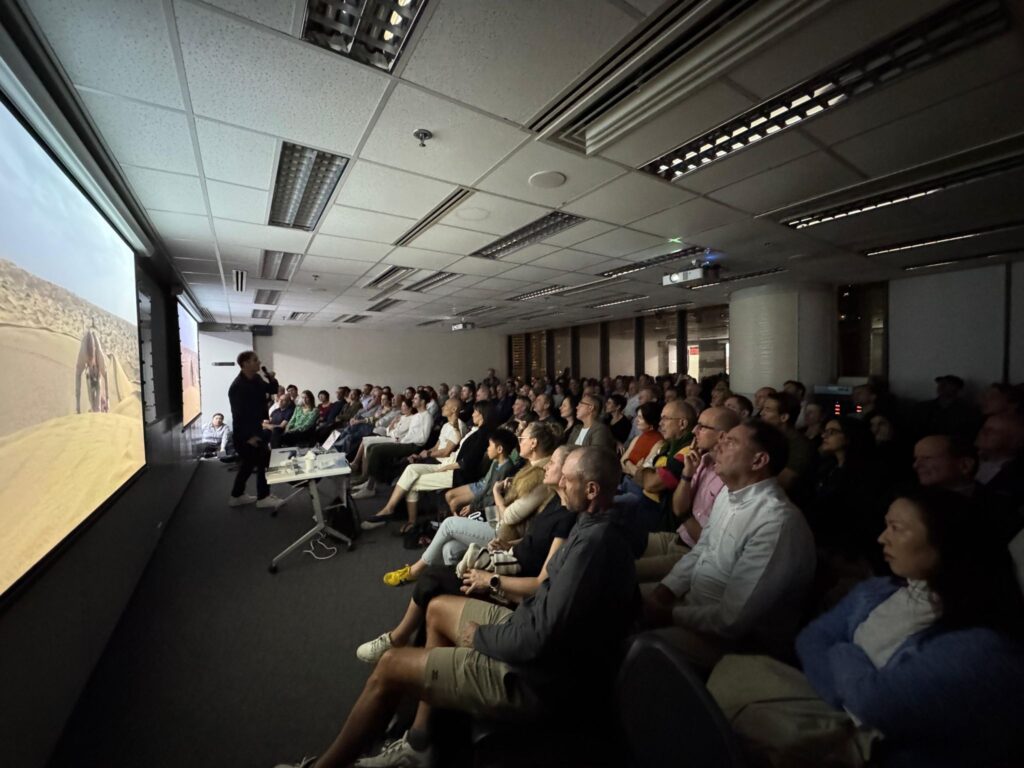
The Royal Geographical Society talk felt different. A smaller room, a more exploratory audience — it gave me space to get personal in ways I rarely do in corporate keynotes. So I talked about the things that usually stay backstage.
Imposter syndrome follows adventurers, too
The internal voice that asks “who do you think you are to attempt this?” doesn’t care how many miles you’ve already covered. Naming that voice — rather than pretending it isn’t there — is the first step in not letting it win.
Fear is not a sign you’re doing the wrong thing
The fear that comes with accepting what feels like an impossible challenge is real, legitimate, and in my experience, a reliable indicator that what you’re attempting actually matters. The goal is not to eliminate the fear — it’s to act in spite of it.
Failure and growth are not opposites
Perhaps the most counterintuitive thing adventure has taught me: even when everything goes wrong, it can still be good for us. The Taklamakan was not a smooth journey. But the difficulty — the moments of genuine crisis — turned out to contain the most valuable lessons. Struggle, processed honestly, tends to become something useful.

This was also a particularly meaningful moment as we had our firstborn son join us for the first time in a talk especially because he features in this story, as an unborn baby!
Three Lessons From Cycling Home From Siberia
After that, I had the privilege of delivering a keynote to over 1,000 key figures from California’s tourism industry at a Visit California event in San Diego. I kept the messaging deliberately light drawing on my 50,000 km Cycling Home From Siberia expedition.

1. When we break a huge goal into parts, it’s amazing what we can achieve.
No one cycles 50,000 km in a day. They cycle it one pedal stroke, one village, one country at a time.
2. When we habitually and intentionally get out of our comfort zone, it’s incredible how we grow.
Deliberately and repeatedly stepping outside your comfort zone doesn’t just build resilience — it accelerates growth in ways that comfort never can. In a world changing as rapidly as ours, this isn’t optional. It’s a survival strategy.
3. Although the headlines are so full of bad news these days, it’s wonderful how much kindness you encounter when you get out into the world.
Across continents and cultures, the dominant experience of venturing out into the world is not danger — it’s generosity. In my expedition, what was constant was the quiet, consistent kindness of the people I encountered.
Why These Stories Matter Beyond Adventure
It’s because the lessons embedded in extreme journeys are, at their core, human lessons.
Organisations everywhere grapple with change, uncertainty, and the pressure to perform. The principles that helped me survive walking the Taklamakan and riding my bike for 50,000 kilometres — breaking the goal down, leaning into discomfort, trusting in people’s fundamental decency — are precisely the same principles that help teams, leaders, and individuals navigate today’s world.
If you’re interested in bringing these themes to your organisation or event, I’d love to hear from you. Contact us at team@roblilwall.com.