







It was a fantastic way to kick off the autumn speaking season: travelling to Dunhuang, China, to deliver an adventure-based keynote for HSBC Private Bank China’s top performers.
Dunhuang is an extraordinary location for a leadership event. An ancient oasis city on the edge of the Gobi Desert, it is surrounded by dramatic landscapes, including enormous sand dunes. As an adventure keynote speaker, I’ve spent years telling audiences stories about crossing deserts and walking through mountain-sized dunes. This was the first time I could actually see them from the conference venue.
It was a memorable setting for a keynote focused on a question that feels increasingly relevant to leaders and teams across Asia:
How do we stay resilient, adapt quickly and keep moving forward when the path ahead is uncertain?
My short answer is: Think Like an Adventurer.
Building Resilience and Adaptability in an Uncertain World
Adventurers rarely have the luxury of knowing exactly what lies ahead.
Conditions change. Plans go wrong. Obstacles appear unexpectedly. Progress requires a combination of resilience, adaptability, resourcefulness and a willingness to keep moving forward.
The same is increasingly true in business.
Through stories from my expeditions around the world, my Think Like an Adventurer keynote explores practical mindsets that can help leaders and teams navigate uncertainty, including:
- Resilience: recovering from setbacks and continuing to make progress.
- Adaptability: recognising when circumstances have changed and adjusting the plan.
- Resourcefulness: making the most of the people, tools and opportunities available.
- Courage: being willing to step outside your comfort zone when the situation demands it.
- Purpose: having a strong enough “why” to keep moving when things become difficult.
AI Translation at an International Conference in China
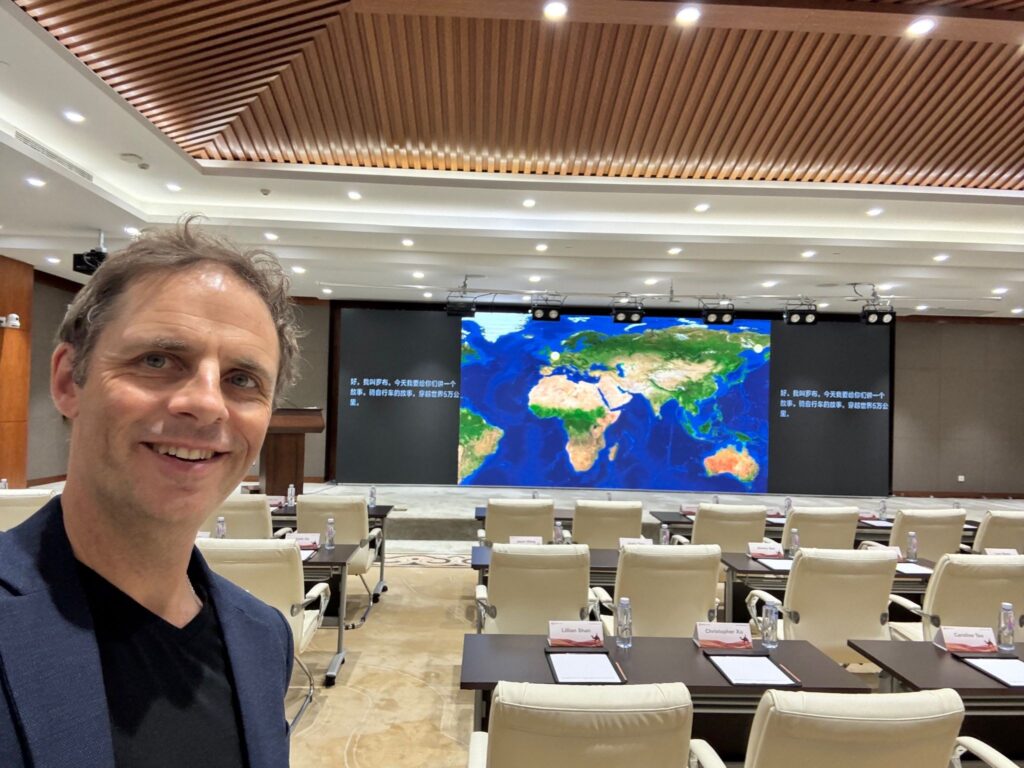
One particularly interesting aspect of the HSBC Private Bank China event was the use of live AI-translated subtitles.
As I delivered the keynote in English, translated subtitles appeared live on screen for the audience.
It was an impressive example of how AI is already changing international conferences and corporate events. For global organisations bringing together multilingual teams, technologies like real-time AI translation could make keynote speeches, leadership conferences and company events significantly more accessible.
I suspect we’ll be seeing much more of this at international events across Hong Kong, Singapore, China and the wider Asia-Pacific region.
From the Conference Stage to the Dunhuang Desert
The following morning, before flying back to Hong Kong, I had a few hours to explore the landscape I had been looking at from the conference venue.
Naturally, I decided to climb the dunes.
Getting there proved slightly more complicated than anticipated. What looked straightforward from a distance involved navigating a maze of farmland and eventually squeezing underneath a large fence through a drainage channel.
But I made it.

Standing among those enormous dunes was a wonderful reminder of why I have always loved deserts — and why adventure continues to provide such a useful metaphor for leadership and business.
You can have a destination in mind, but the route towards it is rarely completely predictable.
Sometimes the path you planned disappears. Sometimes you encounter an obstacle. Sometimes you need to change direction entirely.
The important thing is to keep adapting and moving forward.
A Busy Season of Leadership and Motivational Keynotes Across Asia Pacific
After Dunhuang, I returned home to Hong Kong ahead of a busy few months of speaking engagements.
I’ll be delivering adventure-based motivational, resilience and leadership keynotes for organisations including Amazon Web Services (AWS), bp, Bvlgari, Manulife, Aon, TravMedia, Kuok Group Singapore and Pan Pacific Hotels Group, among others.
Although every organisation and audience is different, many are wrestling with similar questions.
How do we perform when circumstances keep changing?
How do we build resilient teams without simply telling people to “be more resilient”?
How do we adapt to technologies such as AI while keeping people engaged and focused?
And how do leaders create the confidence and momentum needed to move forward when they cannot predict exactly what comes next?