






I’m very happy to share that the audiobook of my first book, Cycling Home From Siberia, is now available — and it’s read by me.
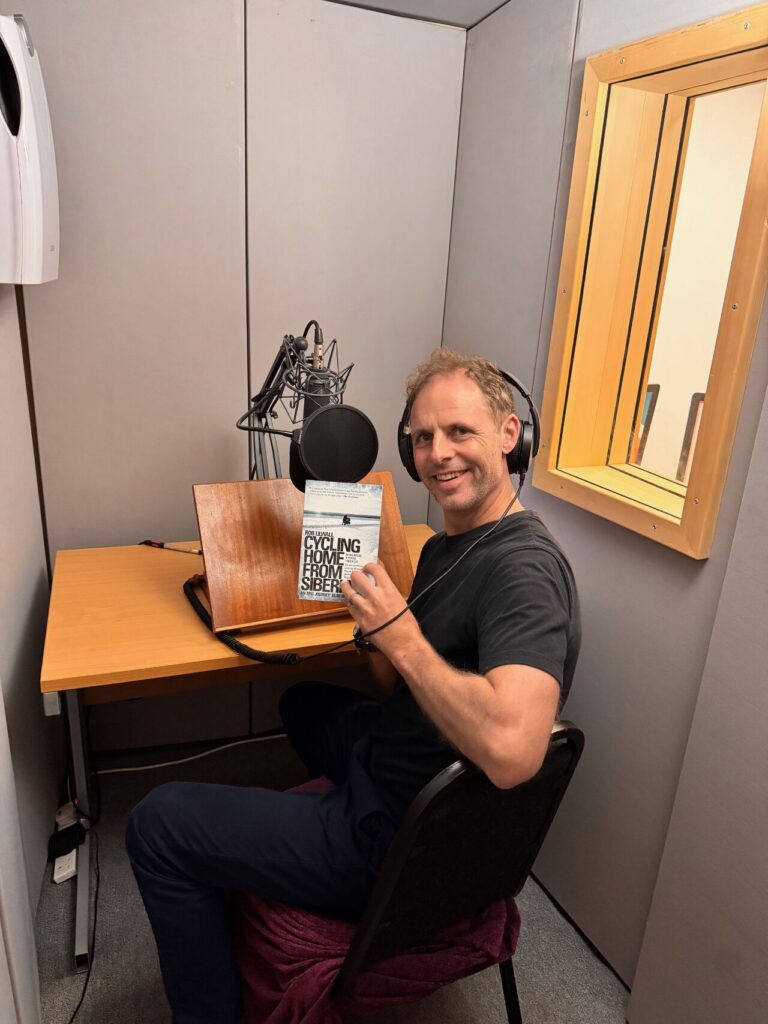
I recorded the audiobook in London earlier this year, nearly 20 years after setting off on the three-year cycling expedition that inspired the book.
It was a fascinating, surprisingly emotional experience.
Revisiting the adventure that changed my life
These days, as a motivational keynote speaker, I regularly tell stories from my biggest expeditions to audiences at conferences and corporate events around the world.
Many of those stories come from Cycling Home From Siberia — my journey cycling more than 30,000 miles from Siberia back to London, travelling through some extraordinary parts of the world along the way.
On stage, however, those stories have usually been carefully shaped into five- or ten-minute episodes. I tell them with the benefit of nearly two decades of hindsight, focusing on the lessons that can help people navigate challenges, uncertainty and change in their own lives.
Recording the audiobook was completely different.
I had to go back and read the whole story.
That meant revisiting the thoughts, fears, mistakes and decisions of myself in my late twenties, as I cycled through places including Siberia, Papua New Guinea and Afghanistan.
Quite a few times, I found myself thinking:
Who was this guy?! Where did he go?!
It was funny at times, but also surprisingly moving.
Spending so much time with “young Rob” reminded me just how profoundly that journey changed my life.
Bravery rarely feels brave at the time
Looking back, I sometimes think the younger version of me seems quite brave.
That certainly wasn’t how it felt at the time.
At the time, I mostly felt scared.
And perhaps that is one of the most important lessons I was reminded of while recording Cycling Home From Siberia.
Bravery rarely feels brave when you’re doing it.
It usually feels uncomfortable.
Stepping outside our comfort zones is, by definition, uncomfortable. There is uncertainty. There is risk. We don’t necessarily know whether things will work out.
But moving into that discomfort can also create enormous opportunities for personal growth, resilience and change.
My cycling expedition took me through some incredible places and challenging situations, but the principle applies far beyond adventure.
In our personal lives and in the workplace, growth often requires us to move towards something that feels uncomfortable rather than away from it.
What is the next brave thing you need to do?
Recording the audiobook also got me thinking about how I can step outside my own comfort zone more often again.
I’ve been reflecting on a question inspired by author Donald Miller:
If you were the hero in a story about your life, what is the next brave thing you would need to do?
It doesn’t have to involve cycling across Siberia or setting off on an enormous expedition.
Your next brave thing might be having a difficult conversation you’ve been avoiding.
It might mean volunteering to lead a project at work, applying for a promotion you don’t feel completely qualified for, asking someone intimidating for help, planning an ambitious family adventure, seeking professional support, or simply saying yes to an opportunity that scares you.
The specifics will be different for everyone.
The important thing is recognising that feeling uncomfortable does not necessarily mean we are moving in the wrong direction.
Sometimes, it means we are growing.
Lessons from adventure for leadership and business
This is one of the reasons I continue to draw on my expeditions in my work as a motivational speaker and keynote speaker for businesses across Asia Pacific and internationally.
You don’t need to be an adventurer to think like an adventurer.
In organisations, people constantly face uncertainty: changing markets, new technologies, ambitious targets, unfamiliar responsibilities and difficult decisions.
An adventure mindset isn’t about taking reckless risks. It is about being willing to move forward when you don’t have all the answers.
It means stepping beyond the familiar, committing to a meaningful goal, asking for help when you need it, adapting when circumstances change, and continuing forward when things become difficult.
Those were lessons I learned on the road.
Nearly 20 years later, they remain central to the ideas I share with leaders and teams around the world.